
1. What Prompt Engineering Actually Means
- Prompt engineering is the practice of designing inputs that produce specific outputs from AI models.
- It emerged as a necessary skill because language models are sensitive to phrasing, context, and structure.
- The way you frame a question directly influences the quality and format of the response.
- In its simplest form, prompt engineering involves writing clear instructions to get useful results.
- You learn what works through trial and error. You refine wording. You add examples.
- You adjust tone. This approach works well for exploration and experimentation.
- However, as AI applications move beyond individual tasks into full systems, the limitations of this approach become visible.
- What works for one-off queries does not always translate to environments where consistency, maintainability, and reliability matter most.
2. Why Traditional Prompting Struggles in Production Environments
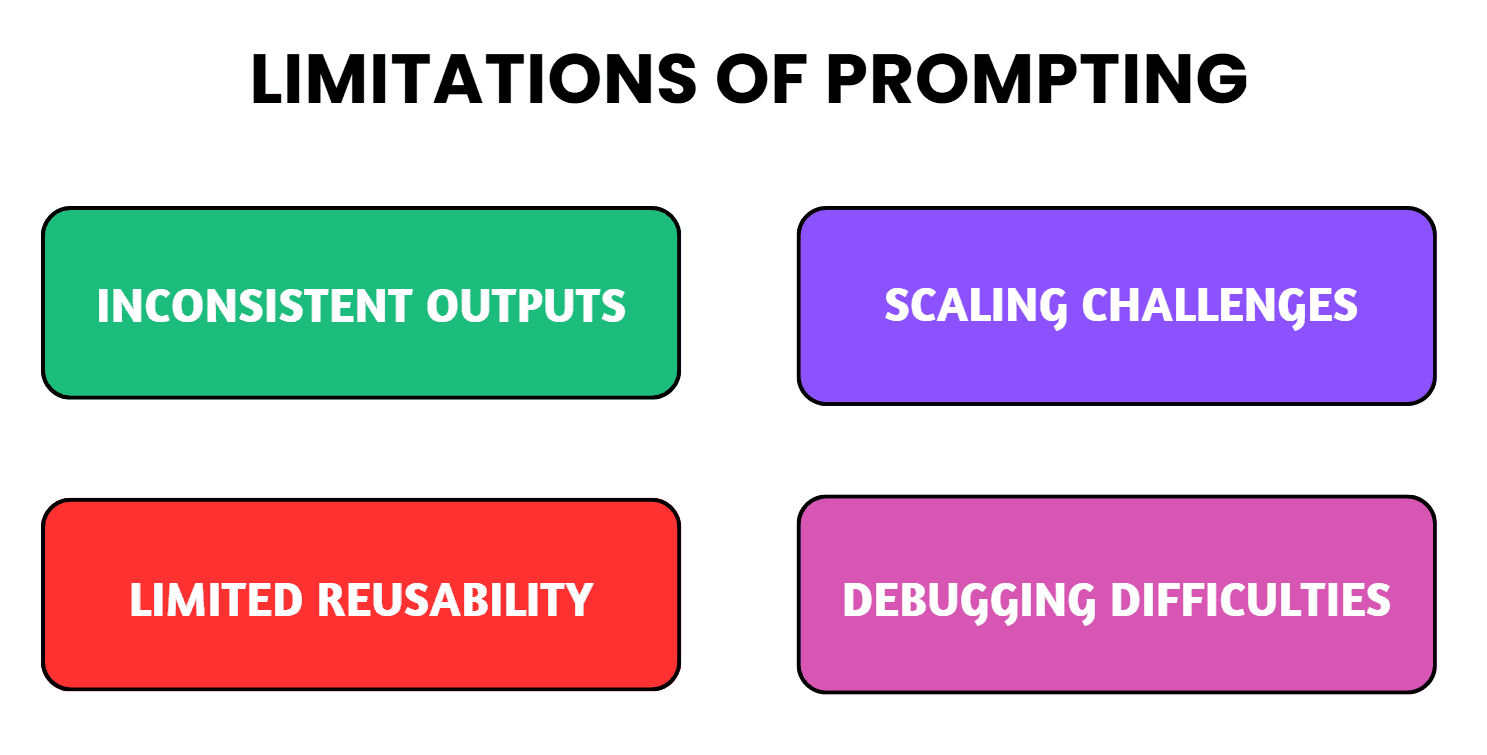
Prompts are excellent tools for testing ideas and exploring possibilities. They allow rapid iteration and creative problem-solving. But when the same approach is applied to production systems, several issues emerge.
2.1 Inconsistent Outputs
The same prompt can produce different results across multiple runs. This variability comes from the probabilistic nature of language models. While this is acceptable during exploration, it becomes problematic when building applications that require predictable behavior.
2.2 Scaling Challenges
As the number of prompts grows, managing them becomes complex. Each new feature or use case often requires a new prompt. Over time, teams end up with dozens or hundreds of prompts scattered across different parts of a system. Tracking which prompt does what, and ensuring they work together, becomes a significant overhead.
2.3 Limited Reusability
Prompts are typically written for specific scenarios. When requirements change or new use cases emerge, you often need to start from scratch. This creates redundancy and makes it difficult to build on previous work.
2.4 Debugging Difficulties
When something goes wrong, identifying the source of the problem is challenging. Is it the wording? The structure? The context? The model version? Without clear boundaries and defined inputs and outputs, troubleshooting becomes guesswork.
2.5 Model Updates Break Existing Prompts
AI models evolve. When a model is updated, prompts that worked perfectly before may behave differently. This drift means constant maintenance and adjustment, which can be time-consuming and unpredictable. These challenges do not mean prompts are ineffective. They simply highlight that prompts alone are not designed for long-term, large-scale systems.
3. The Evolution of Prompting Techniques
Prompting has evolved significantly over time. Understanding this progression helps clarify where we are and where things are heading.
3.1 Basic Prompting
- Zero-shot prompting: involves asking the model to complete a task without any examples. You provide an instruction and expect a response. This is fast and requires minimal setup, but results can be unpredictable.
- Few-shot prompting: adds examples to guide the model. By showing the AI what good outputs look like, you improve consistency. This approach works better than zero-shot but still depends heavily on how well your examples represent the task.
3.2 Structured Prompting
- Role-based prompting: assigns the AI a persona or perspective. For example, "You are a financial analyst reviewing quarterly reports." This adds context and helps shape the tone and depth of responses.
- Step-by-step instructions: break tasks into clear stages. Instead of asking for a summary, you might say: "First, identify the main topics. Second, summarize each topic in one sentence. Third, combine them into a coherent paragraph." This reduces ambiguity and improves accuracy.
- Instruction layering: combines multiple elements into one prompt. You define role, tone, format, and logic together. This gives more control but also makes prompts longer and harder to manage.
3.3 Advanced Prompting
- Prompt templates: introduce reusable structures with placeholders. Instead of writing each prompt from scratch, you create a template and fill in variables. This is where prompting starts to resemble software engineering.
- Prompt pipelines: chain multiple prompts together to handle complex workflows. The output of one prompt becomes the input for the next. This allows for multi-step processes but requires careful coordination.
- Context engineering: involves managing memory, retrieval, and state across interactions. This is necessary for applications that need to remember past conversations or access external data. It also adds complexity and potential points of failure.
Each level adds capability but also increases the difficulty of maintaining and scaling the system.
4. When Prompts Become Difficult to Manage
There is a transition point where prompts stop being tools and start becoming liabilities. You know you have reached this point when:
- You start version-controlling prompts like code
- You need internal tools to manage and organize them
- Debugging prompts takes as long as debugging software
- Changes to one prompt break another part of the system
At this stage, you are no longer doing simple prompt engineering. You are building AI-driven software. And software benefits from structure, testing, and clear specifications. This is where spec-driven development becomes relevant.
5. Spec-Driven Development: Defining Structure for AI Behavior
Spec-driven development shifts the focus from crafting instructions to defining specifications. Instead of asking the AI to interpret what you want, you define exactly what the input should look like and exactly what the output must contain.
This approach treats AI as a function within a system, not as an open-ended conversational partner.
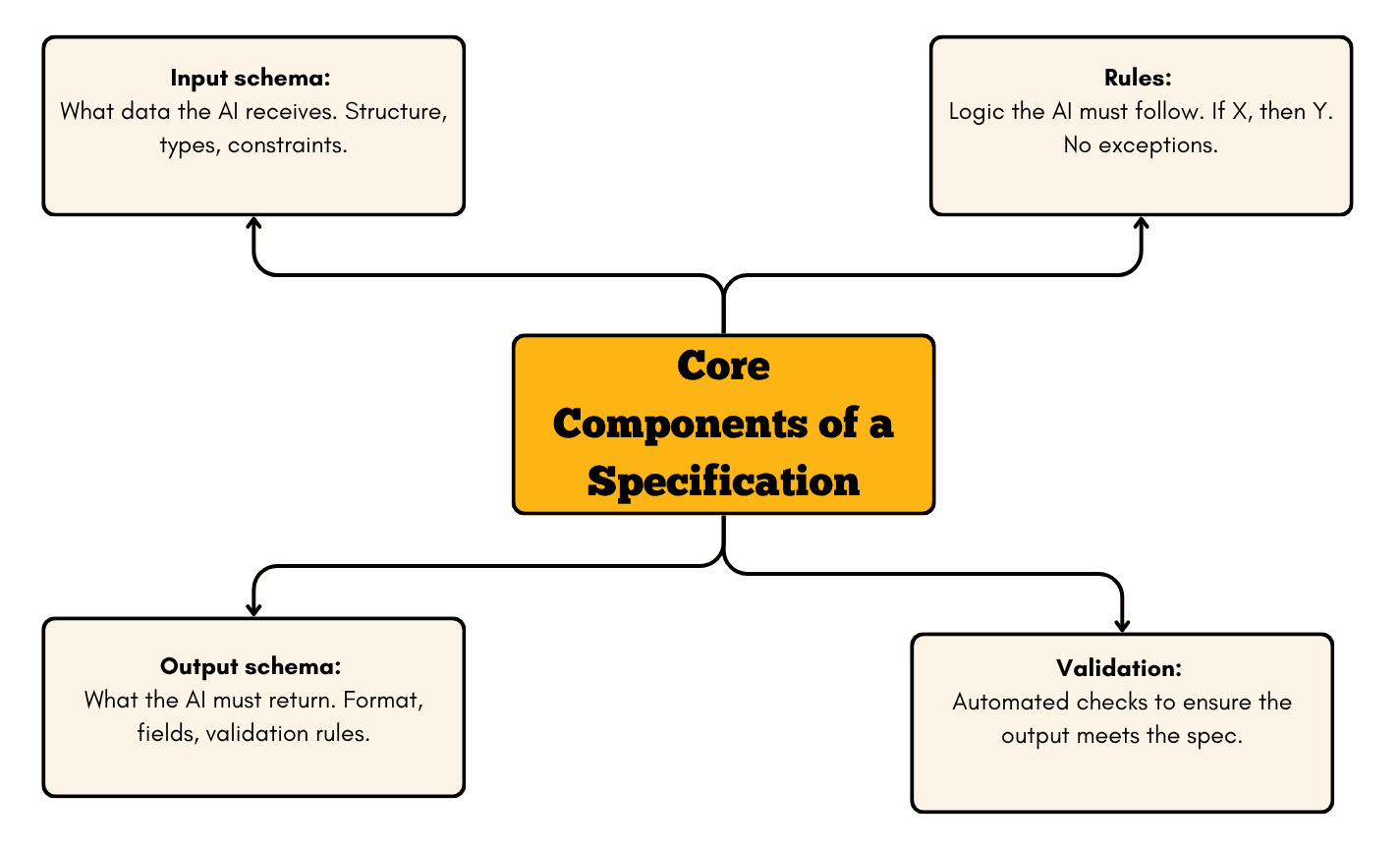
5.1 Core Components of a Specification
- Input schema: defines what data the AI receives. This includes structure, data types, and constraints. For example, if the AI processes user profiles, the input schema specifies which fields are required and what format they should follow.
- Output schema: defines what the AI must return. This ensures every response follows the same structure, making it easier to process and validate downstream.
- Constraints: set hard limits on behavior. These might include maximum length, required tone, or forbidden content. Constraints remove ambiguity.
- Rules: define logic the AI must follow. For example, "If the user age is under 18, do not include certain fields." Rules ensure consistent decision-making.
- Validation: involves automated checks to ensure outputs meet the specification. If an output does not match the schema or violates a constraint, the system can reject it or retry.
This is not about replacing prompts entirely. It is about adding structure where structure is needed.
Looking to apply AI in your business? We build custom AI solutions including intelligent agents, chat support systems, document processing, automation, data insights, and forecasting tools designed for real business use. Explore our AI Solutions page to see how we can help.
6. Practical Example: Certificate Generation System
Consider building a system that generates certificates for course completions.
6.1 Traditional Prompting Approach
You might write: "Generate a certificate for a user who completed the course. Include their name, course title, and completion date. Make it professional."
This works initially. But then edge cases appear. What happens if the name contains special characters? What if the course title is too long to fit on the certificate? What if the date is in an inconsistent format?
You start adding more instructions. You provide examples. You list exceptions. The prompt grows into a long paragraph. And even then, new edge cases emerge.
6.2 Spec-Driven Approach
Instead of refining the prompt, you define what the system should do in every scenario.
You specify:
- Name: Must be between 2 and 50 characters. Special characters are allowed but formatted consistently.
- Course title: Maximum 60 characters. If longer, truncate and add ellipses.
- Date: Always formatted as "Month Day, Year" (e.g., "January 15, 2026").
- Output format: JSON object with fields: name, course_title, completion_date, certificate_id.
- Error handling: If any field is missing or invalid, return an error message with the specific issue.
This specification ensures consistency. Every certificate follows the same structure. Edge cases are handled in a defined way. Changes to the format are made in one place, not scattered across multiple prompts.
7. Why Specifications Improve Reliability
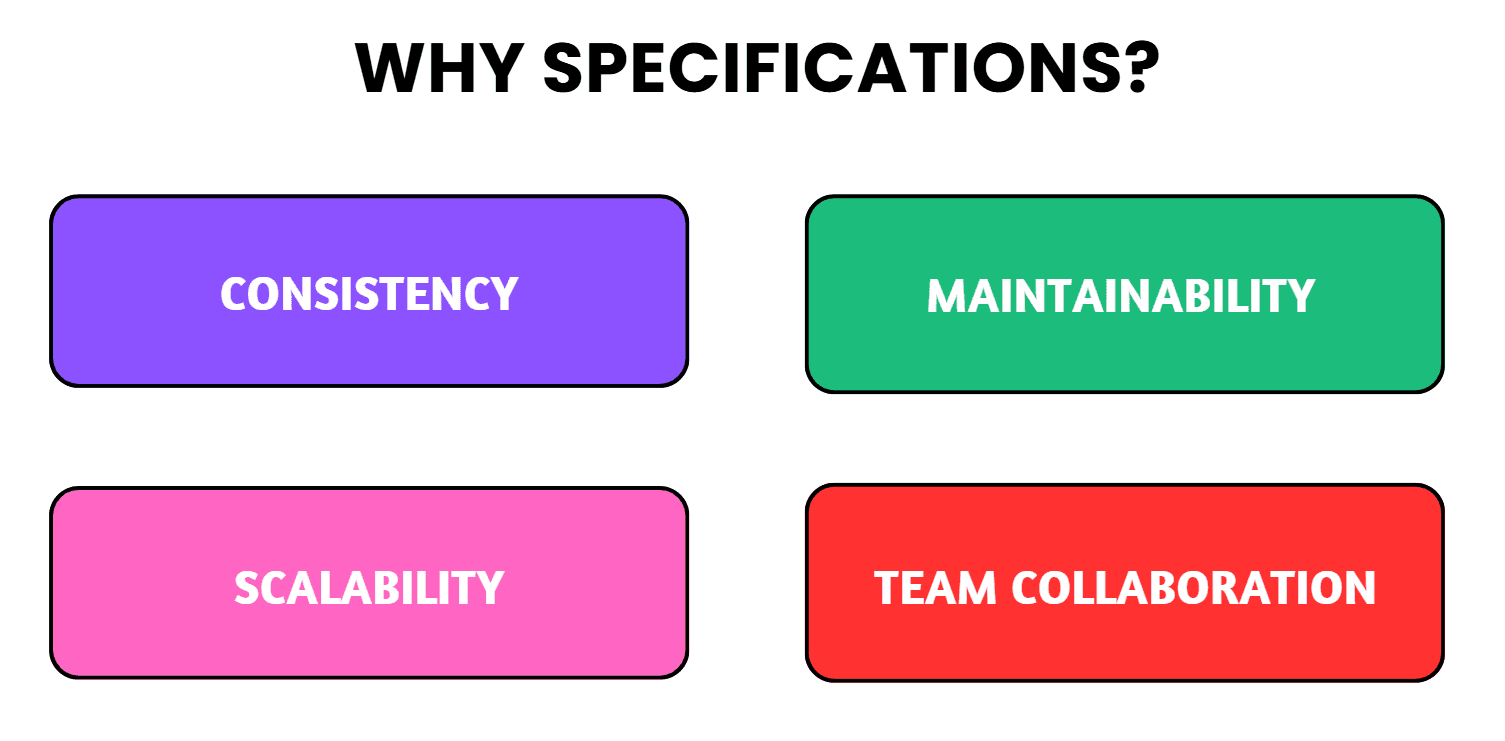
Specifications provide several advantages over traditional prompting, especially in production environments.
7.1 Consistency
When you define a specification, the same input always produces the same structure. This predictability is critical for systems that need to integrate with other components.
7.2 Maintainability
If you need to change how something works, you update the specification in one place. You do not need to hunt through dozens of prompts to find where the logic is defined.
7.3 Scalability
Adding new features becomes easier. Instead of writing new prompts from scratch, you extend existing specifications or create new ones that follow the same patterns.
7.4 Team Collaboration
Specifications provide clear contracts. Developers can work on AI components the same way they work on APIs. There is no ambiguity about what goes in and what comes out.
7.5 Production Readiness
Specifications can be tested, versioned, and deployed like any other code. You can write automated tests to verify that outputs meet requirements. You can track changes over time. You can roll back if something breaks.
8. When Not to Use Spec-Driven Development
Spec-driven development is not always the right choice.
8.1 Quick Tasks
If you need a one-time answer or a simple output, writing a specification is unnecessary. A straightforward prompt is faster and more practical.
8.2 Creative Writing
If the goal is exploration and creativity, specifications can be restrictive. Prompts allow for open-ended responses, which is valuable when you want the AI to generate ideas or explore possibilities.
8.3 One-Off Use Cases
If there is no need for reuse, no team involved, and no long-term maintenance, adding structure may be over-engineering.
Specifications are most valuable when building systems that need to be reliable, repeatable, and maintainable over time.
9. The Tradeoff Between Prompts and Specifications
Both approaches have their place. Understanding the tradeoff helps you choose the right tool for the situation.
9.1 Flexibility vs Control
Prompts are flexible. They allow the AI to interpret and adapt. Specifications are controlled. They define exact boundaries and expectations.
9.2 Speed vs Reliability
Prompts are fast to write and iterate on. Specifications take more time upfront but provide reliable, predictable results.
9.3 Exploration vs Production
Prompts are excellent for exploring what is possible. Specifications are built for production environments where consistency matters. Most teams start with prompts. As systems mature, many transition to more structured approaches.
10. Common Mistakes That Weaken Prompting Effectiveness
Even if you are not ready to adopt specifications, avoiding certain mistakes can improve the reliability of your prompts.
10.1 Vague Instructions
Instructions like "Make it good" or "Improve the text" provide no clear direction. The AI has no way to know what "good" means in your context.
10.2 No Output Format
If you do not define the shape of the output, you will get inconsistent results. Some responses might be bullet points. Others might be paragraphs. Some might include extra information you did not ask for.
10.3 Mixing Logic and Data
Separate what changes (data) from what stays the same (logic). If your prompt includes both, it becomes harder to reuse and maintain.
10.4 Overcomplicated Prompts
If your prompt is ten sentences long and covers multiple conditions, it has become a system. At that point, treating it as a structured component makes more sense. Prompts work best when they are clear, concise, and purpose-built for a specific task.
11. The Future of AI Development
The industry is moving toward AI engineering. This means treating AI components as parts of larger systems, not as standalone tools.
11.1 Systems Over Prompts
Instead of writing individual prompts, teams are building workflows. These workflows define how data flows through AI components, how outputs are validated, and how errors are handled.
11.2 Structured Inputs and Outputs
Defining contracts between AI components and the rest of the system ensures compatibility and reduces integration issues.
11.3 Reusability and Testing
AI components are being treated like any other software module. They are tested, versioned, and reused across different parts of the application.
Spec-driven development is one step in this direction. It is not the final destination. As AI capabilities and tooling mature, new approaches will emerge. Just as prompting evolved into specifications, specifications will evolve into more sophisticated methods.
The people succeeding with AI today are not necessarily the best at writing prompts. They are systems thinkers who understand how to integrate AI into reliable, maintainable workflows.
12. Final Thought
Prompting is the starting point. It is how you learn what AI can do and how it responds to different inputs. It is valuable for experimentation, creative tasks, and quick solutions.
But if you want to build something that lasts, something a team can maintain, something that works reliably in production, you need structure. You need to shift from viewing AI as a conversational tool to treating it as a structured component within a system.
Spec-driven development offers one way to achieve this. It is not the only approach, but it is proving to be one of the most reliable for production environments.
In the end, the choice depends on your goals. If you are exploring, prompts are enough. If you are building, structure matters. And in production environments, reliability often becomes more important than flexibility.