

What Is Automation? A Clear Definition
Automation refers to the use of technology to carry out tasks with minimal or no human involvement. At its core, automation follows a predetermined set of instructions: if a specific condition is met, a specific action occurs. The process is rule-based, predictable, and repeatable.
Industrial automation is perhaps the most familiar example. In manufacturing plants, robotic arms weld components along an assembly line, conveyor systems sort packages by weight, and temperature sensors trigger safety shutoffs, all without a person physically involved in each step. The logic behind every action was written in advance by a human engineer.
In the digital world, automation takes the form of scheduled reports that generate at the same time every week, email sequences that trigger when a user clicks a link, or accounting software that reconciles transactions at the close of each business day. The defining characteristic remains the same: automation executes a fixed workflow. It does not learn. It does not decide. It does not adapt.
Quick Definition: Automation is the use of predefined rules and logic to execute tasks without ongoing human input. It is reliable, scalable, and consistent, but operates only within the boundaries it was programmed to handle.
Types of Automation
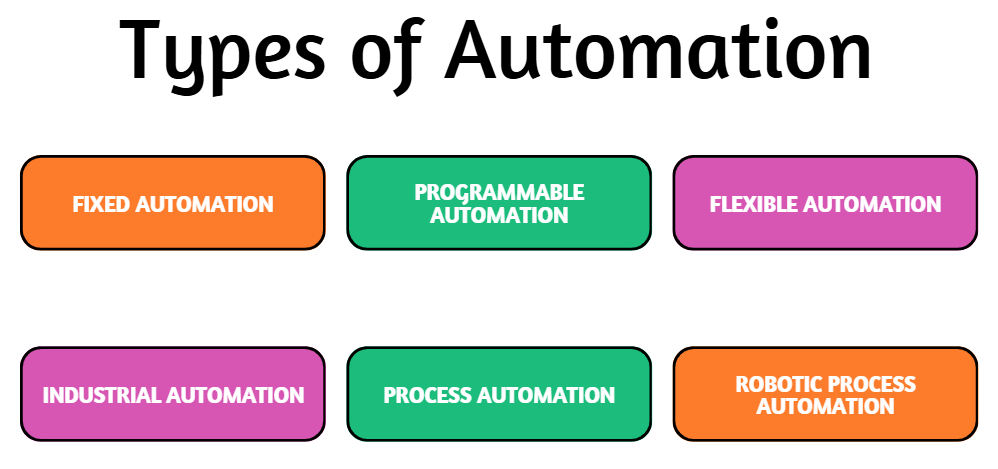
- Fixed Automation: It is also called hard automation, this type is designed to perform a single repetitive task with no flexibility. It is commonly used in high-volume industrial manufacturing where the process rarely changes. Automotive assembly lines are a classic example.
- Programmable Automation: This type allows the system to be reprogrammed to handle different tasks or product variations. It is widely used in batch production environments where the process needs to change periodically. CNC machines and industrial robots fall into this category.
- Flexible Automation: It is also known as soft automation, this type can switch between tasks with minimal reprogramming or downtime. It is designed for environments where product variety is high and changeovers need to happen quickly. Modern smart factories rely heavily on flexible automation systems.
- Industrial Automation: This refers to the use of control systems, machinery, and software to automate physical processes in manufacturing and production environments. It covers a broad range of technologies including sensors, PLCs, and robotic systems working together on the factory floor.
- Process Automation: This type focuses on automating business and operational workflows rather than physical tasks. It streamlines repetitive digital processes such as data entry, report generation, and approval workflows across departments and systems.
- Robotic Process Automation (RPA): RPA uses software bots to mimic human actions within digital interfaces such as applications and browsers. It is widely adopted in finance, HR, and operations to automate rule-based tasks like invoice processing, data migration, and system updates.
Where Automation Excels
Automation is extraordinarily effective when tasks are structured, high-volume, and repetitive. Payroll processing, inventory restocking alerts, form submissions, and quality control checks in manufacturing are all categories where automation delivers measurable value. The speed and accuracy are difficult to match through manual effort, and once configured correctly, the system runs with little ongoing oversight.
What Is Artificial Intelligence? Beyond the Buzzword
Artificial intelligence is the broader discipline of building systems that can perform tasks typically associated with human cognitive ability: understanding language, recognizing patterns, drawing conclusions, and making decisions based on context. Unlike automation, AI is not restricted to a predefined set of rules. Instead, it learns from data and improves its performance over time.
A language model, for instance, can read a block of text it has never encountered before and produce a coherent summary. An image recognition system can identify objects in a photograph it was not explicitly trained to classify. A recommendation engine can suggest products to a user based on behavioral patterns it has inferred rather than rules it was handed.
This capacity to handle ambiguity, work with unstructured information, and generalize from experience is what separates AI from classical automation. The machine is not simply executing a script. It is making inferences, and those inferences get better as more data flows through the system.
Types of Artificial Intelligence
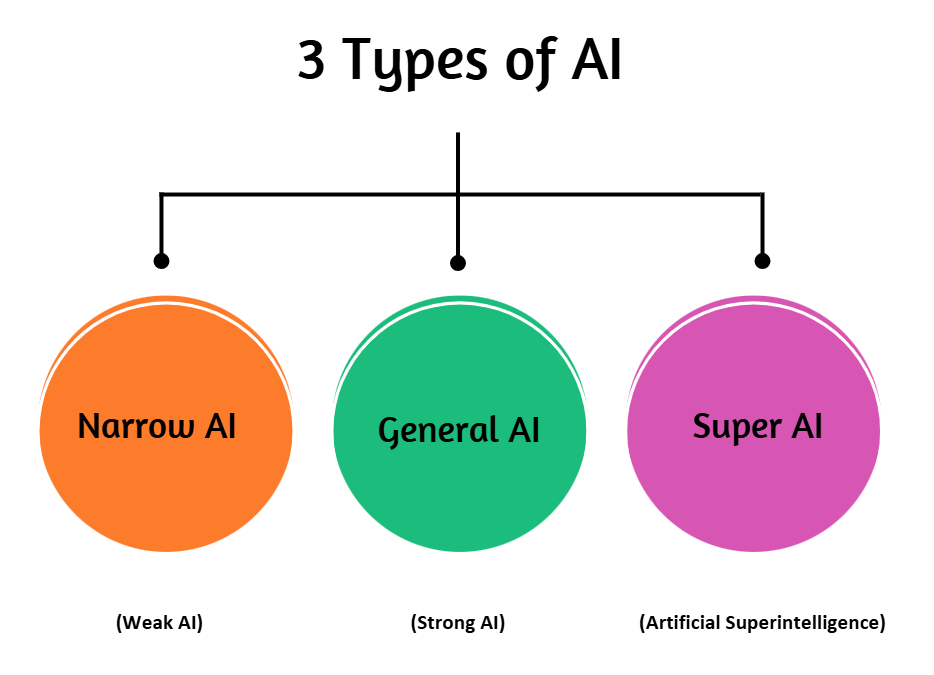
- Narrow AI (Weak AI): This is the most common form of AI in use today. It is designed to perform one specific task or a closely related set of tasks and cannot operate beyond that defined scope. Virtual assistants, spam filters, image recognition systems, and product recommendation engines are all examples of narrow AI working effectively within their boundaries.
- General AI (Strong AI): This type refers to an AI system that can perform any intellectual task a human can, with the same level of reasoning, understanding, and adaptability across different domains. General AI does not exist in a fully realized form yet and remains an active area of research. It represents the long-term ambition of the field rather than a current capability.
- Super AI (Artificial Superintelligence): This is a theoretical concept referring to an AI system that surpasses human intelligence across every domain, including scientific reasoning, social understanding, creativity, and decision-making. It is widely discussed in the context of future AI development and its potential implications. As of today it remains entirely hypothetical and is not yet within the reach of current technology.
The Role of Machine Learning
Much of modern AI is built on machine learning, a subset of the field in which algorithms are trained on large datasets to identify patterns. Rather than a human writing explicit logic for every scenario, the model learns the underlying structure of the data and applies that understanding to new situations. This is why AI can handle tasks that would be impossible to automate through rule-based systems alone, such as detecting sentiment in a customer review or translating a sentence from one language to another.
Automation vs. AI: Key Differences Explained
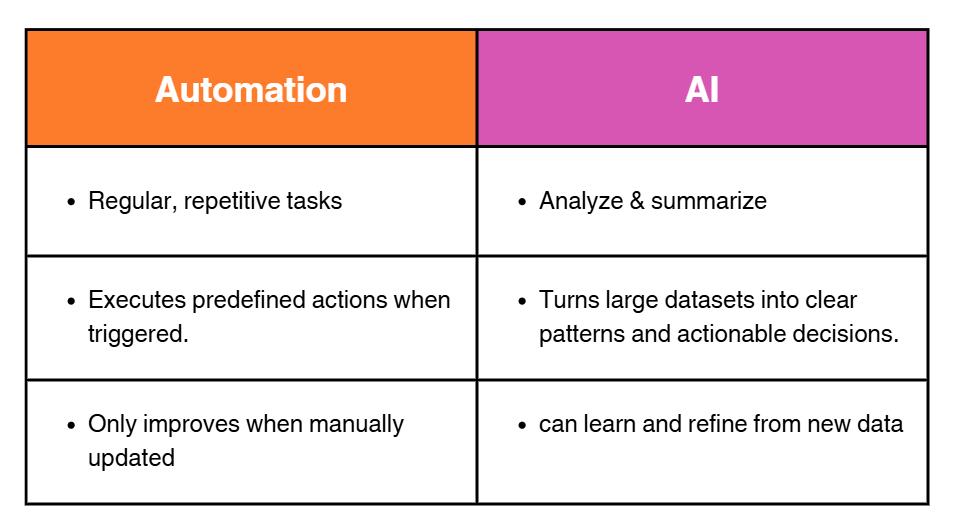
The easiest way to understand the distinction between automation and AI is to think about how each system handles something it has not seen before. Automation stops working or produces an error. AI attempts to reason through the new situation and respond appropriately.
A practical illustration: an industrial automation system on a production line can detect a component that falls outside a specified dimension and flag it for removal. However, if the production process changes and the acceptable dimension range shifts, the system must be manually reconfigured. An AI-driven quality inspection system, by contrast, can be retrained on new acceptable standards and begin applying updated judgment relatively quickly.
Automation handles the "what," working through a task with precision and consistency. AI handles the "which," making decisions based on context, probability, and inference.
Can Automation and AI Work Together?
Yes, and in many of the most effective technology implementations today, they do. Automation and AI are not mutually exclusive categories. They are complementary capabilities that, when combined, produce systems greater than either could achieve independently.
Consider a customer support pipeline. An AI model can analyze an incoming support ticket, understand the nature of the problem, categorize the urgency, and draft an initial response. Once the AI has made those judgments, automation handles the downstream steps: routing the ticket to the appropriate team, sending a confirmation email to the customer, and logging the interaction in the company's database. The intelligence and the execution work in concert.
AI automation, the practice of combining AI-driven decision-making with automated execution of the resulting actions, has become a significant operational category. In supply chain management, AI models forecast demand patterns, and automation systems immediately adjust inventory orders in response. In healthcare, AI analyzes diagnostic images and flags findings, while automated workflows route those findings to the appropriate clinical team for review.
The key principle is that AI informs and automation executes. Each does what it is genuinely well suited for, and together they create workflows that are both intelligent and efficient.
What Is Agentic AI? A New Category of Intelligent Systems
Agentic AI represents a significant conceptual step beyond both classical automation and standard AI applications. An AI agent is a system that can pursue a goal across multiple steps, make decisions at each stage, use tools and external data sources, and adapt its approach based on what it encounters along the way. Where conventional AI produces an output in response to a single prompt or input, an agent works through a sequence of actions to accomplish a broader objective.
The distinction is meaningful in practice. A standard AI model asked to research a topic will generate a response based on what it already knows. An AI agent given the same task can search the web, read and synthesize multiple documents, compare findings, identify gaps in its understanding, run additional searches to fill those gaps, and compile a structured report, all as part of a continuous, self-directed workflow.
Types of AI Agents: A Practical Overview
AI agents vary considerably in their architecture and the scope of tasks they handle. Understanding the main types helps clarify where each is most valuable.
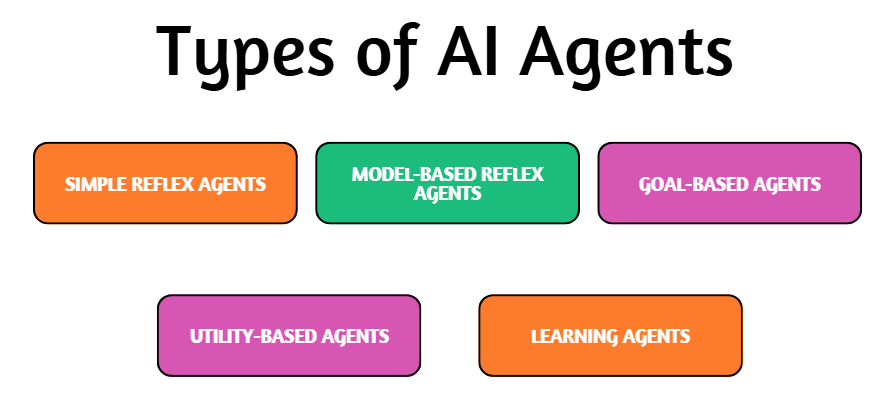
- Simple Reflex Agents: These agents respond directly to the current input based on a set of predefined condition-action rules. They have no memory of past events and no awareness of future consequences. They work well in fully observable environments where the right action can always be determined from the current situation alone. A thermostat that turns on heating when the temperature drops below a set point is a straightforward example of this type.
- Model-Based Reflex Agents: These agents maintain an internal model of the world, allowing them to keep track of information that is no longer directly visible in the current input. This internal representation helps the agent handle partially observable environments where not everything relevant is immediately available. The agent uses both its current perception and its stored model of the world to decide what to do next.
- Goal-Based Agents: These agents act with a specific goal in mind. Rather than simply reacting to the current state, they evaluate possible actions based on whether those actions bring them closer to achieving their objective. This requires a degree of planning and forward-thinking that simple and model-based reflex agents do not possess. Goal-based agents are better suited for tasks where the path to the desired outcome involves multiple steps and decisions.
- Utility-Based Agents: These agents go a step further than goal-based agents by not just asking whether a goal will be achieved but how well it will be achieved. They use a utility function to measure the desirability of different outcomes and choose actions that maximize that value. This makes them better equipped to handle situations where multiple goals may conflict or where trade-offs between competing outcomes need to be evaluated.
- Learning Agents: These agents improve their performance over time through experience. They observe the results of their actions, receive feedback on what worked and what did not, and update their behavior accordingly. Learning agents are the most adaptable of the five types and are the foundation of much of modern AI, where systems are trained on large amounts of data rather than programmed with explicit rules.
Traditional AI vs. Agentic AI
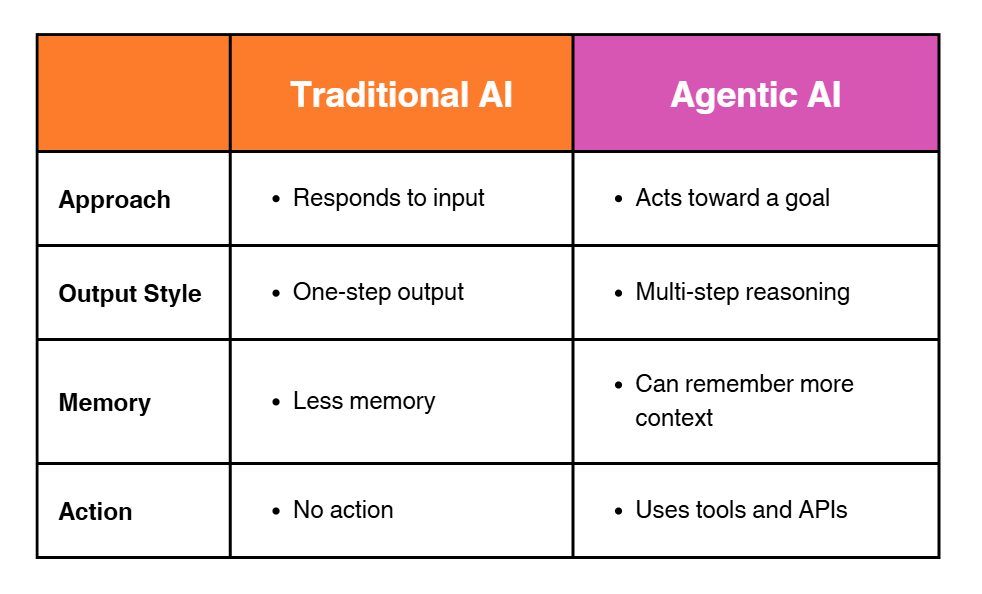
Example of Traditional AI: You type a question into an AI chatbot and it gives you an answer. The interaction ends there. The system does not follow up, does not search for additional information, and does not take any action on your behalf. A customer support chatbot that reads your query and returns a preset response is a straightforward example of traditional AI at work.
Example of Agentic AI: You give an AI agent the task of booking a meeting with a client. It checks your calendar for availability, drafts an email to the client with proposed time slots, waits for the response, confirms the time, and adds the meeting to your calendar automatically. The agent reasoned through multiple steps, used external tools, and completed the full task from start to finish without needing you to manage each step.
A Brief History: How Agentic AI Evolved
The idea of an autonomous AI agent is not new. It traces back to the early decades of computer science, when researchers in the 1950s and 1960s began exploring the concept of systems that could act on their own to achieve a defined goal. Early AI programs like the General Problem Solver, developed in 1957, attempted to simulate human reasoning by working through problems step by step. These were rule-based systems with very limited scope, but the underlying ambition, building something that could reason and act toward an objective, was already present.
Through the 1980s and 1990s, the field of multi-agent systems emerged in academic research. Agents during this period were largely symbolic, meaning they operated on structured logic and hand-coded knowledge. They could navigate simple environments, play games, or simulate economic behavior, but they were brittle. Step outside their programmed boundaries and they failed entirely.
The shift began with the rise of machine learning in the 2000s and accelerated sharply with deep learning in the early 2010s. As AI models became capable of understanding language, recognizing images, and reasoning over unstructured data, the building blocks for genuinely capable agents began to fall into place.
The real inflection point came between 2022 and 2024. Large language models reached a level of general reasoning ability that made them practical foundations for agentic systems. Frameworks like LangChain, AutoGPT, and CrewAI emerged to help developers connect language models to tools, memory systems, and external data sources. What had been a research concept for decades became a practical engineering discipline almost overnight.
By 2025 and into 2026, agentic AI moved from experimental projects into production deployments across industries. Legal research, software development, customer operations, financial analysis, and scientific research are all areas where AI agents are now performing meaningful work alongside human teams.
What Makes an AI System Truly Agentic
Several characteristics define an agentic AI system. First, it operates with a degree of autonomy, taking actions without requiring human instruction at each step. Second, it uses tools, such as web browsers, code interpreters, databases, and APIs, to interact with the world beyond its own knowledge. Third, it plans, breaking down a complex goal into smaller steps and sequencing those steps toward the objective. Fourth, it responds to feedback, adjusting its approach when early steps produce unexpected results.
How to Build an AI Agent: The Core Components
Building an AI agent does not require starting from scratch. Most modern agents are assembled from a set of well-defined components, each handling a specific part of what makes the system work.
The Foundation Model: Every agent starts with a large language model or a similarly capable AI model at its core. This is the reasoning engine. It interprets instructions, decides what action to take next, processes information returned from tools, and generates outputs. The quality and capability of the foundation model directly determines how reliably the agent reasons through complex tasks.
Tools and Integrations: An agent without tools is just a language model. Tools are what give an agent the ability to act in the world. These can include web search, code execution environments, file readers, database connectors, calendar and email APIs, or any external service the agent needs to complete its task. The agent calls these tools as needed and uses the results to inform its next decision.
Memory: Agents need memory to function effectively across multi-step tasks. Short-term memory holds the context of the current task, what has been done, what was returned, and what still needs to happen. Long-term memory allows the agent to store and retrieve information across sessions, which is critical for personalized or ongoing workflows. Most agent frameworks today use a combination of in-context memory and external vector databases for this purpose.
Planning and Reasoning: The ability to break a goal into smaller steps and sequence those steps logically is what separates a capable agent from a simple chatbot. Some agents use a technique called chain-of-thought reasoning, where the model thinks through a problem step by step before acting. Others use more structured planning frameworks where the agent generates a full task plan before execution begins and then monitors its own progress against that plan.
Feedback and Correction Loop: Reliable agents do not just execute blindly. They evaluate their own outputs, check whether a step produced the expected result, and adjust their approach if something went wrong. This self-evaluation loop is what makes agents robust enough to handle real-world tasks where unexpected situations are the norm rather than the exception.
Human Oversight Layer: Most production-grade agent deployments include a human-in-the-loop mechanism for high-stakes decisions. The agent flags actions that cross a defined threshold, such as sending an external communication, making a financial transaction, or modifying a critical database, and waits for human confirmation before proceeding. This layer is not a limitation of the technology. It is a deliberate and responsible design choice.
Conclusion: Three Distinct Layers of Intelligent Technology
Automation, artificial intelligence, and agentic AI are not synonyms, nor are they competing approaches. They represent three distinct and increasingly powerful layers of technology, each building on the capabilities of the one before.
Automation brings reliability and scale to structured, repetitive tasks. AI brings the ability to handle ambiguity, learn from data, and apply judgment to complex situations. Agentic AI takes these capabilities further by enabling systems to pursue goals across extended sequences of decisions, use tools, and operate with meaningful autonomy.
As these technologies continue to mature through 2026 and beyond, clarity about what each layer does and does not do will remain one of the most practically useful forms of knowledge available to professionals across every industry. The organizations and individuals who invest in that understanding now will be significantly better positioned as these systems become a standard part of how knowledge work is organized and executed.
Key Takeaways
- Automation follows predefined rules and cannot adapt; AI learns from data and handles ambiguity.
- Industrial automation excels at structured, high-volume, repetitive tasks in manufacturing and operations.
- AI automation combines AI decision-making with automated execution for end-to-end intelligent workflows.
- Agentic AI pursues goals across multiple steps using tools, planning, and real-time adaptation.
- Types of AI agents include reactive, deliberative, learning, tool-using, and memory-augmented systems.
We are building an AI system designed specifically for SMEs and MSMEs to bring this kind of intelligence into their own workflows, privately and securely. If you are curious about how document-based AI can work for your organization, take a closer look at what we are working on View Product.
What's Next: A Glimpse at Multi-Agent AI
Agentic AI is already reshaping how work gets done, but the next evolution goes even further. Multi-agent AI, where multiple specialized AI agents work together toward a shared goal, is rapidly emerging as one of the most significant developments in this space.
We will be covering this topic in depth in our next piece. Stay tuned.